Pace Takes Line Honours: Four Chapters, One Great Adventure
.jpeg "Volvo 70 Pace © Paul Wyeth/RORC")
RORC Round Britain and Ireland Race - Sunday 16 August 2026
Johnny Vincent's Volvo 70 Pace has completed the 50th anniversary RORC Round Britain and Ireland Race, winning Monohull Line Honours after a race that combined raw speed, complex navigation and a deeply personal offshore journey for the owner.
Johnny Vincent's Volvo 70 Pace crossed the Royal Yacht Squadron finish line in Cowes at 04:17:31 BST on Sunday 16 August, taking Monohull Line Honours in the 2026 RORC Round Britain and Ireland Race. Her elapsed time for the 1,805-nautical-mile course was 6 days, 14 hours, 47 minutes and 31 seconds.
The YB tracker recorded 2,113 nautical miles sailed, close to the shortest route, save two deviations after Black Rock and in the northern North Sea. The great acceleration came off the west coast of Ireland and towards Muckle Flugga where the Juan Kouyoumdjian design exploited the conditions that suited her. Vincent recalled a 486-nautical-mile run in 24 hours and boat speeds of 26 and 27 knots.
The final miles were an entirely different contest. Pace sailed VMG downwind past Norfolk, Suffolk, Kent, Sussex and Hampshire, negotiating a maze of traffic separation schemes, oil and gas infrastructure, wind farms and exclusion zones. The crew completed an intense series of never-ending gybes in the pitch black of night before a favourable tide helped carry Pace through the Solent and home to Cowes.
At the time of writing, Pace is also in pole position for IRC Overall after time correction. Her corrected time is fixed, but Vincent and his crew must now wait for the remaining contenders, including Antoine Magre's Mach 50 Palanad 4 to finish before the overall result can be decided.
.jpeg) Pace finishes the RORC Round Britain and Ireland Race 2026 © Craig Nutter/Pace
Pace finishes the RORC Round Britain and Ireland Race 2026 © Craig Nutter/Pace
Johnny Vincent - A tremendous adventure
For Vincent, the first emotion on stepping ashore shortly after 04:00 was not simply triumph, but the scale of what had been completed.
"A big sense of completion is how I would describe it," said Vincent. "It has been a long journey and a tremendous adventure. What an amazing race and what an amazing event. We had all sorts of conditions: no wind, lots of wind, flat sea, big waves and some great scenery.
"It is wonderful to achieve Line Honours. The boat is really built for an adventure like this and at times, we were doing amazing speed and that is a wonderful feeling. It has been an immense learning curve for me personally," he said. "The longest trip I had ever done offshore was Gibraltar to Southampton, about 1,300 or 1,400 miles. I have done the Middle Sea Race, the Caribbean 600 and the Fastnet, but this was three times the distance and three times the effort.
"I have been surrounded by an amazing team of people. They have been kind to me, given me good guidance and taught me a great deal. I have stepped ashore feeling like a much more competent ocean sailor, and that is a very special thing to take away."
Vincent described the race as four distinct chapters joined into one extraordinary book.
"The Round Britain and Ireland Race is not one yacht race," he explained. "It is a series of four races joined together. You do it chapter by chapter and then reach the end of the book when you come back to Cowes. That makes it totally unique.
"The first chapter takes you through familiar Fastnet waters. Chapter two runs from south-west Ireland to Muckle Flugga in a completely different ocean environment. Chapter three begins when you turn at Muckle Flugga. There is this extraordinary emotion that you are going home, but you are further north than Cape Horn is south.
"Then comes the North Sea, with oil platforms and gas rigs. The final chapter is probably the most challenging navigationally, with obstructions, separation zones, depth, sand and a very narrow passage through Dover. It arrives when everybody is beaten up and tired, but there is still a lot more to do."
For Vincent, the fastest miles produced one of the defining memories of the race. "We did 486 miles in a 24-hour stretch," said Vincent. "We had a good solid breeze and a fantastic wave pattern. Surfing at 27 knots is exciting for anybody. It was absolutely thrilling."
Vincent's strongest words were reserved for the team and the preparation that allowed them to push Pace without a major gear failure.
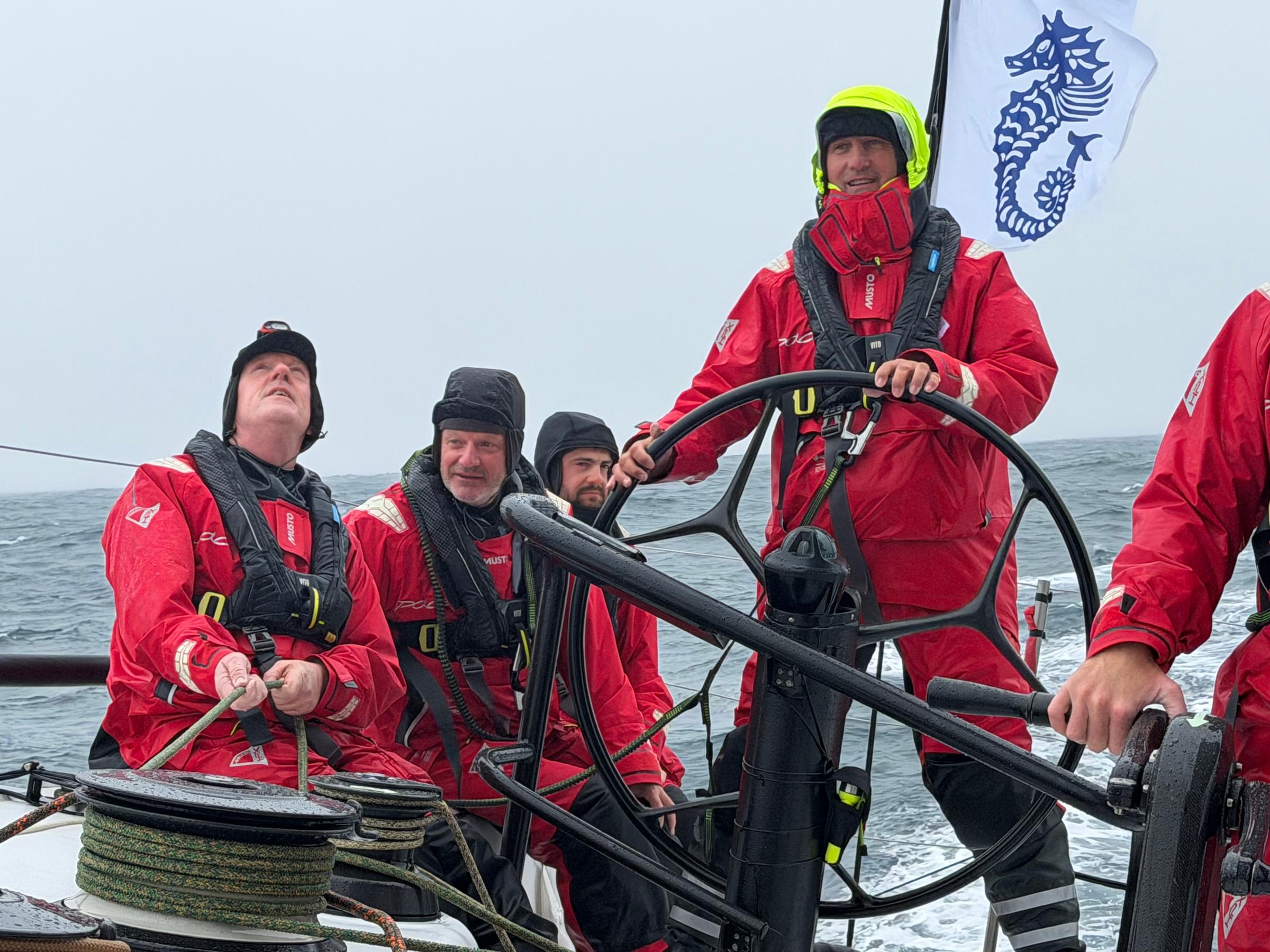 Team Pace © Anthony Haines
"The spirit on the boat was extraordinary. There was not one moment when heads went down. The banter could be hilarious, but when the breeze changed, everybody instantly changed gear.
"For somebody who is not a professional sailor to be told, 'You can step up and drive, Johnny. We have got your back, but get on with it,' was amazing. I feel very humbled that these people wanted to spend their time with me.
"Preparation gives you the confidence to push the boat really hard. Not recklessly hard, because there is always a margin, but really hard. My understanding of what this boat can cope with has moved up massively. She is part of the team."
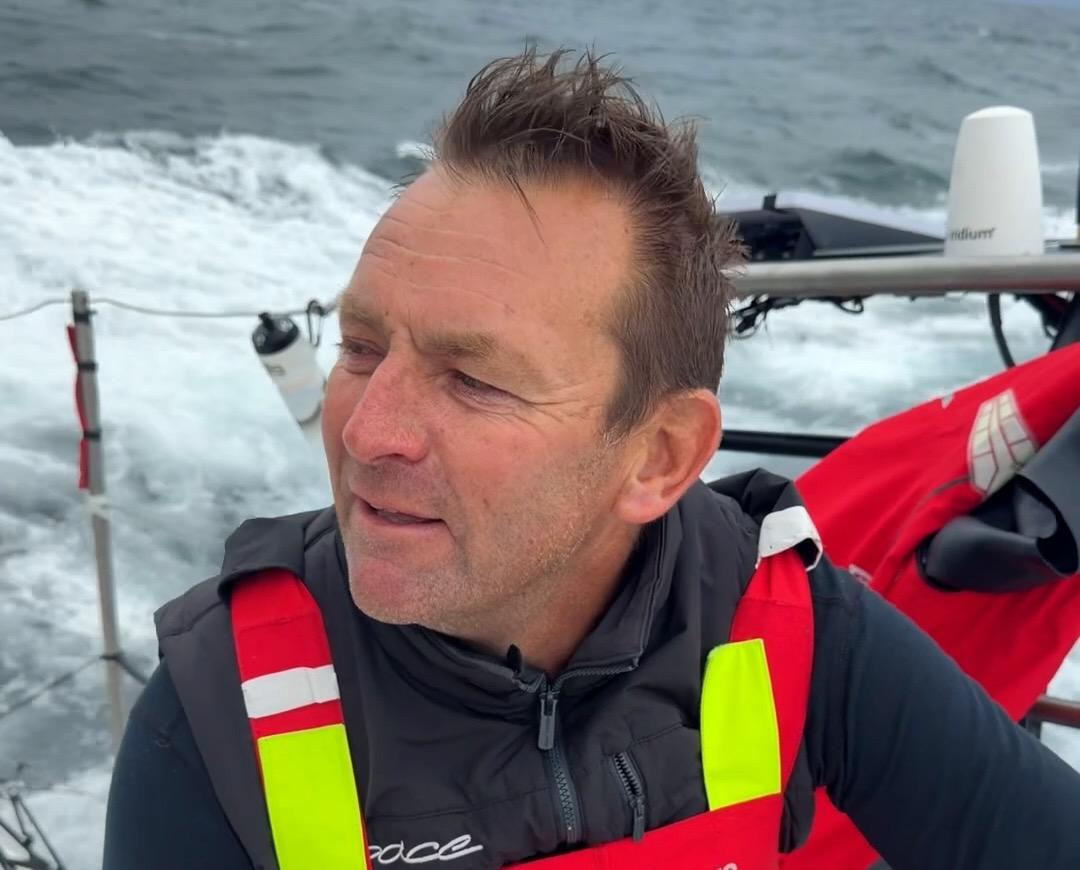
Jules Salter - Give it the right angles and let it go
Navigator Jules Salter has raced thousands of miles in Volvo 70s and won the 2008-09 Volvo Ocean Race aboard Ericsson 4. Pace, which won the following edition as Groupama 4, is a platform he knows and admires. However, this was Salter's first complete RORC Round Britain and Ireland Race.
"When you are racing around Britain, you are effectively turning right at every corner," said Salter. "You combine that with the weather and keep the boat at its fastest and most efficient angle. If you minimize the distance and sail faster for a shorter distance, you will do better.
"There were opportunities to push hard when it was easy to push hard and to gain from a wind shift, a wind bend or something in the forecast. We tried to do that all the way around the course."
That explains why the shortest line was not always the fastest route. "In a corrected time race, the boats have different speeds and characteristics," Salter explained. "We were in the North Sea while other boats were still in the North Atlantic. You have to play the weather hand you are dealt and do what is right for your boat."
When the opportunity arrived west of Ireland, the answer was to release the full potential of Pace.
"It is my favourite type of boat, a Volvo 70, and this Juan Kouyoumdjian design is best of breed," said Salter. "The boat has the performance. You have to let it go and give it the right wind angles and conditions.
"The crew were incredibly sharp at getting the right sails up and down, then making the small angle changes needed to keep the boat fully on pace. You are looking at the sea state, wave angles and which little shifts to take. If you keep doing that, suddenly the boat covers hundreds of miles relatively easily."
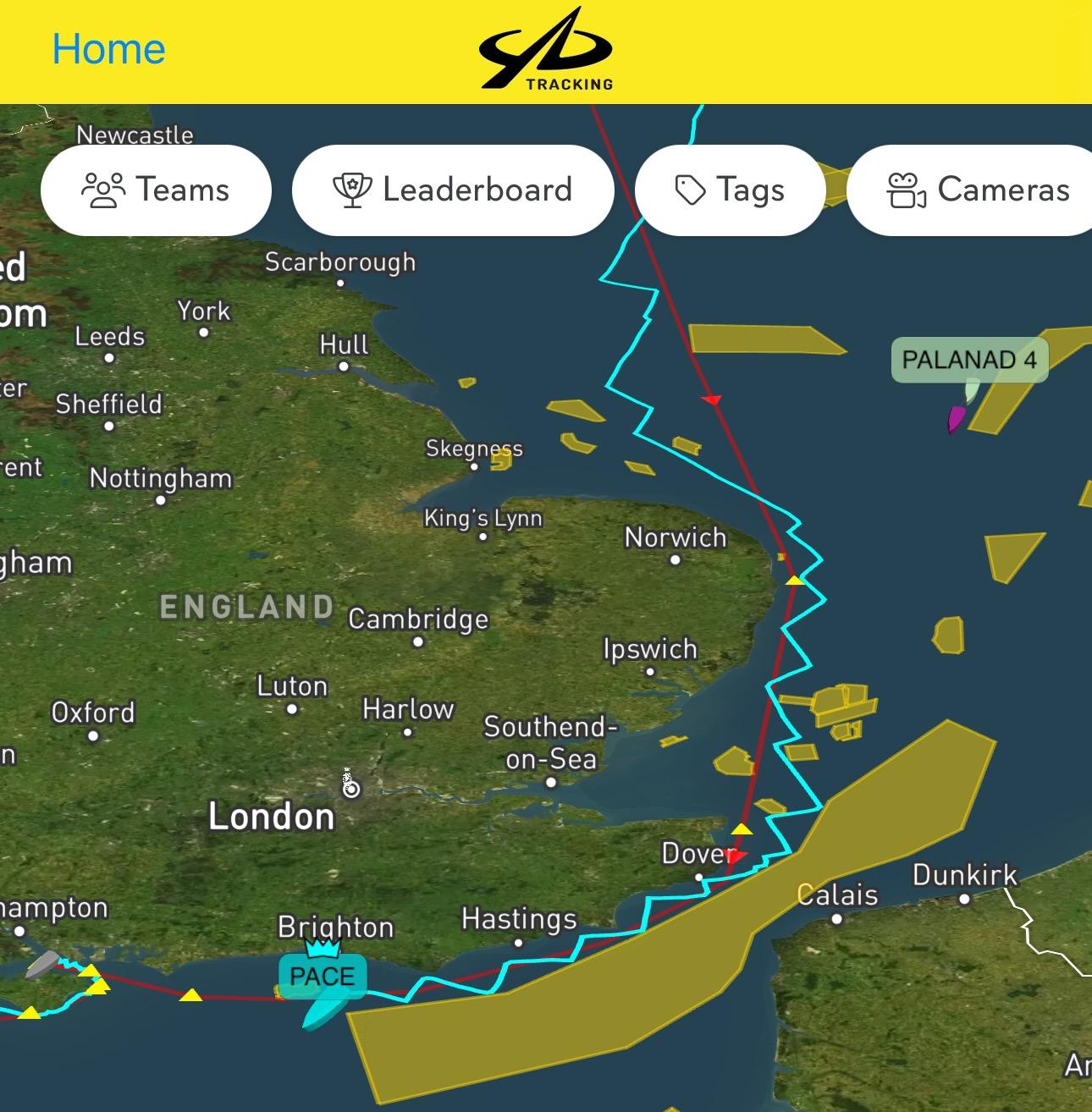 © YB Races
The last quarter of the course demanded a completely different form of precision.
"In the southern North Sea there are gas fields, oil fields, shipping separation zones and wind farms. They have hard boundaries that you cannot see. You understand how they fit together, overlay the weather, choose the best gaps and set up for the next obstacle.
"After that, the crew have to execute. There were a lot of gybes, sometimes waking people 30 minutes into what was supposed to be a four-hour off-watch because we had to gybe again. That trust between the navigator and the crew is incredibly important."
Even with four Volvo Ocean Races behind him, Salter was emphatic about his first complete lap of Britain and Ireland.
"I have raced around Britain as part of the Volvo Ocean Race and I know many pieces of the coastline," he said. "But to string it all together in one complete race is a massive challenge. It is one of the best races.
"I have grown up on the Isle of Wight, so it is very special to start and finish in Cowes. All the great races used to be here, and now the Admiral's Cup is back as well. It is pretty cool to do a 2,000-mile race starting and finishing in your hometown."
For Vincent, the finish brought the story back to the simple reason the programme began.
"I am a normal bloke. I am not a professional sailor," he said. "To set out on this adventure was really special. It is beginning to sink in now. It is a long way, and it has been a great journey."
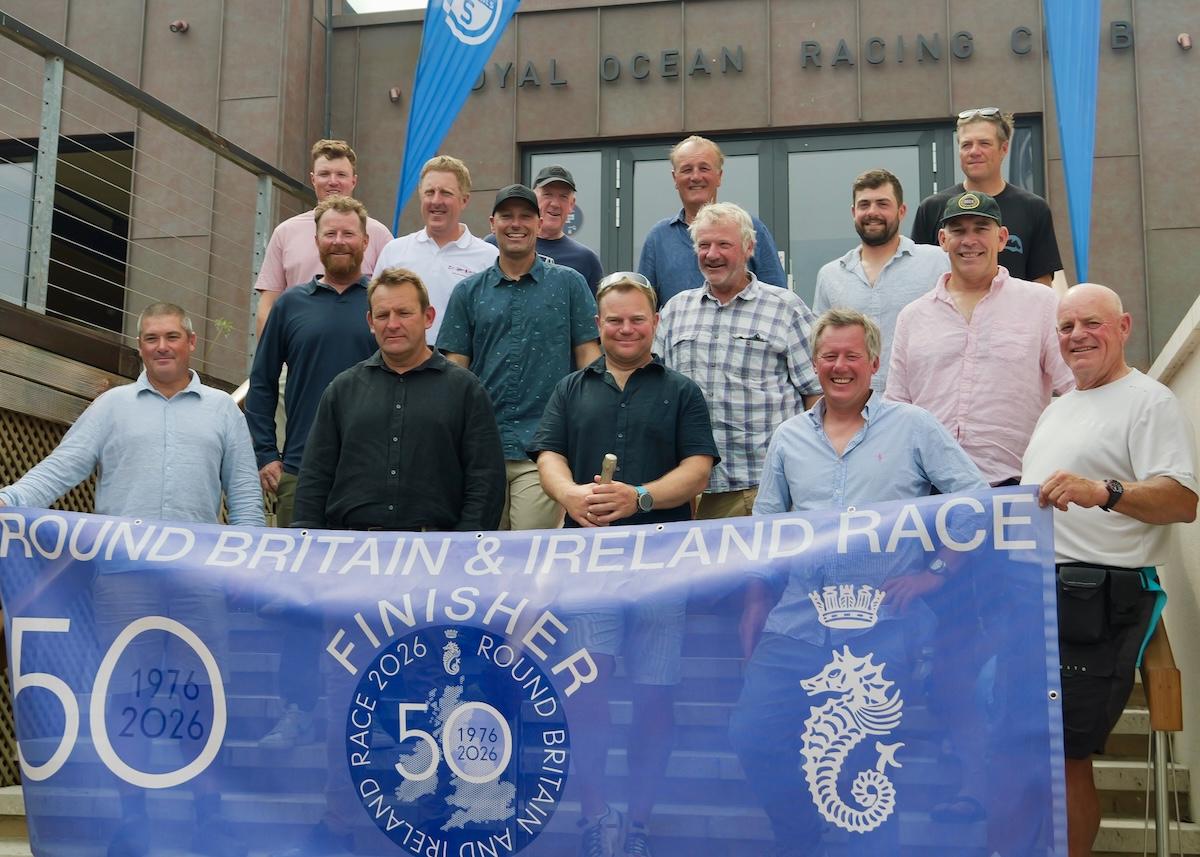
Johnny Vincent and the crew celebrated Team Pace’s achievement with a celebratory lunch at the RORC Cowes Clubhouse
© Corinna Haines/Haines Films
Pace crew: Johnny Vincent, Al Fraser, Anthony Haines, Antonio Cuervas-Mons, Ed Myers, Jim Carroll, Jules Salter, Luke Molloy, Mark Bartlett, Neal McDonald, Pete Cumming, Stu Bannatyne, Tom McWilliam and Trystan Seal.