
Corinthian Spirit: Argyll’s Bermuda Victory
.jpeg "Crew of Hinkley 48 Argyll")
RORC member Christopher Burnham and his Corinthian crew aboard the Hinckley 48 Argyll** claimed a memorable victory in the 2026 Newport Bermuda Race.
First held in 1906, the Newport Bermuda Race predates the Fastnet Race by almost two decades and has a legitimate claim to being one of the cradles of the classic 600-mile offshore race. Its early pioneers set out to prove that well-prepared amateur sailors in relatively small yachts could safely race hundreds of miles across open ocean.
The connection with RORC is direct. British sailor and writer Weston Martyr competed in the 1924 Bermuda Race and returned home captivated by ocean racing. His enthusiasm helped inspire the first Fastnet Race the following year, deliberately created at a similar distance. At the finish in Plymouth, the Ocean Racing Club was formed, with the original objective “to provide annually one ocean race not less than 600 miles in length”. A century later, that shared Corinthian heritage remains very much alive.
.jpeg) Hinkley 48 Argyll
Hinkley 48 Argyll
In the 2026 Newport Bermuda Race it was RORC member Christopher Burnham and his Hinckley SW 48 Argyll who provided another chapter, winning the Finisterre Division and the Carleton Mitchell Finisterre Trophy.
More Than a Cruising Class
Formerly known as the Cruising Class, the Finisterre Division occupies an important place in the Newport Bermuda Race. The division is named in honour of Carleton Mitchell’s celebrated yacht Finisterre, winner of three consecutive Bermuda Races in 1956, 1958 and 1960. Today the division is designed principally for Corinthian crews, with restrictions on professional participation and sail inventory.
Do not, however, mistake “Corinthian” for casual. Many sailors in this division are experienced racing serious offshore yachts over the decades, and the competition is intense. It is a form of racing where preparation, seamanship, teamwork and good decision-making can be every bit as important as having the latest sails or a professional crew. That suited Argyll perfectly.
“It was just an amazing race, really four races rolled into one,” explained Burnham. “We roared down the line at the start and Saturday we caught a Gulf Stream eddy at just the right moment. We never ran out of at least some wind, and then match raced the final day against our sister ship, Northeast Wind.”
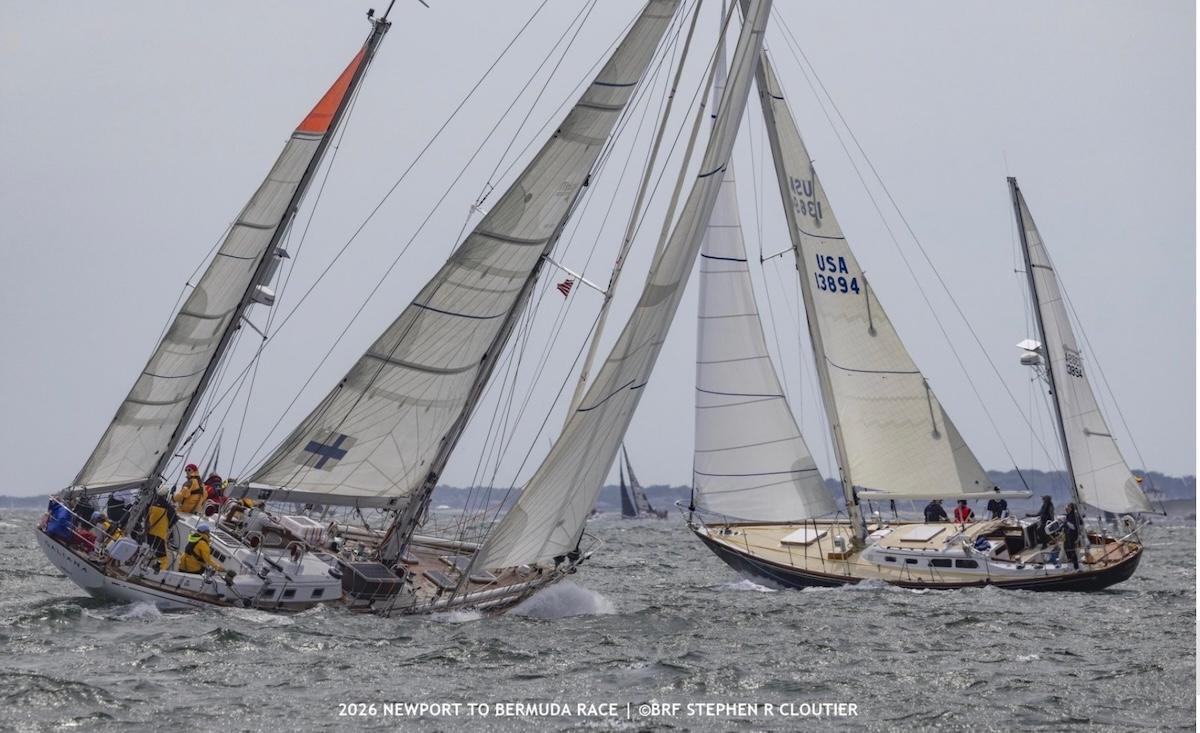
That final encounter provided a fitting climax. Northeast Wind, Frank Sobchak’s Hinckley 48, arrived as the defending Finisterre champion from 2024. Two closely related yachts were therefore fighting for the division on the final approach to Bermuda. For Burnham, however, the decisive ingredient aboard Argyll was not simply the boat.
A Team Built Over Time
“I also had an exceptional team, all of us from the Gibson Island Yacht Squadron, so we’ve been together for over two years and, as we say in the Marines, we’re now a hardened and well tested combat team!” There is something distinctly Corinthian about that description.
Argyll was not assembled around a collection of professional specialists brought together for one event. The campaign was built around sailors who knew one another, had spent time racing together and had gradually developed the trust and understanding that becomes so valuable offshore.
That is an aspect of yacht racing that can sometimes be overlooked in an era dominated by increasingly sophisticated technology. Offshore racing remains a human sport. Boats can be optimised and weather models studied in extraordinary detail, but eventually a crew has to make decisions, change sails, keep the boat moving through the night and trust the people around them.
The 636-mile passage from Newport to Bermuda provides plenty of opportunities to test those relationships. The Gulf Stream alone can transform a promising race into a difficult one, with the positioning of currents and eddies potentially producing significant gains and losses.
For Argyll, catching the right eddy was one part of the puzzle. Maintaining momentum, keeping wind throughout the race and finally defending their position against Northeast Wind completed it.
.jpeg)
Ben Litvinas, William Herbert (RORC), Peter Feldman, Chris Burnham (RORC, captain of Argyll), Richard Herbert (RORC), Jim Schwab, Pierce Spitler
A Strong RORC Connection
There is another reason why Argyll’s success should resonate with RORC members. Burnham is himself a long-standing RORC member and a frequent visitor to the Clubhouse at St James’s when in London. The wider Argyll story also includes Richard Herbert, whose association with RORC stretches back to the 1970s and his son Will Herbert who is also a RORC member. The connection across generations reflects something important about the Club. RORC encompasses professional sailors at the very highest level of the sport and some of the world’s most advanced racing yachts, but that has never been its sole purpose.
The Club was founded by amateurs who wanted to race offshore. In its earliest years, qualification for membership required a sailor to have competed in one of the Club’s ocean races as an owner or crew member and, significantly, to be an amateur. The language and the sport have changed enormously over the subsequent century, but the Corinthian sailor remains at the heart of RORC. That makes competitions such as the Finisterre Division particularly relevant today.
There should be space in major offshore races for sailors who want to compete seriously without turning their campaigns into professional programmes; for friends who build a crew over several seasons; for families who pass offshore sailing between generations; and for boats that might spend part of their lives cruising but, when the starting gun fires, are raced every bit as hard as their crews know how.
The 600-Mile Tradition
There is an appealing symmetry to a RORC member winning this particular trophy in this particular race. The Newport Bermuda Race first demonstrated that amateur sailors in modest-sized yachts could race offshore. Weston Martyr brought that enthusiasm back across the Atlantic. The Fastnet Race followed, and from the Fastnet came the club that became the Royal Ocean Racing Club. More than 100 years after the first race to Bermuda, Argyll and her crew are still demonstrating many of those same qualities.
The boats are faster, weather information is vastly more sophisticated and modern navigation would have been unimaginable to those early ocean racers. However, the fundamentals remain remarkably familiar: prepare the boat, build a good crew, make sound decisions and sail hard for 600 miles. For Christopher Burnham and the Argyll team, doing exactly that was good enough to bring home the Carleton Mitchell Finisterre Trophy.