
Brian Thompson | Still Chasing the Next Horizon
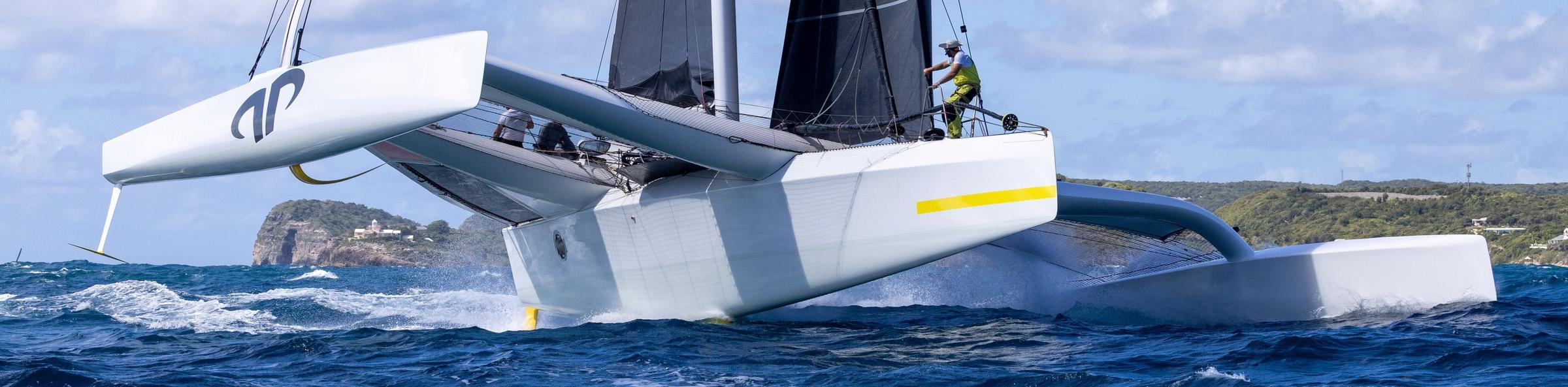
Long-standing RORC Member, Brian Thompson, has competed on some of the fastest offshore yachts ever built and his enthusiasm for racing remains undimmed. As part of Jason Carroll’s Argo Racing, he is now involved in a new project to build a maxi-trimaran that could redefine what is possible on the world’s oceans.
There are few sailors on a RORC start line with a record comparable to Thompson’s. His career encompasses four circumnavigations, a fifth-place finish in the Vendée Globe, victory in the Volvo Ocean Race, the Jules Verne Trophy and more than 40 world sailing records.
Yet for Thompson, the attraction of offshore racing remains rooted in the same fundamentals: fascinating courses, changing weather, fierce competition and the challenge of extracting the best possible performance from a boat and its crew.
.jpg) Brian Thompson © Arthur Daniel/RORC“I always love doing RORC races,” says Thompson. “The UK-based races have some classic, beautiful courses such as St. Malo, the Fastnet and the Round Britain and Ireland Race. They are absolutely fascinating, and every time you sail them it is completely different because of the weather and the tides around the UK.”
Brian Thompson © Arthur Daniel/RORC“I always love doing RORC races,” says Thompson. “The UK-based races have some classic, beautiful courses such as St. Malo, the Fastnet and the Round Britain and Ireland Race. They are absolutely fascinating, and every time you sail them it is completely different because of the weather and the tides around the UK.”
He believes the depth of competition within RORC fleets will continue to grow, driven in part by the resurgence of the Admiral’s Cup and the extraordinary development of short-handed offshore racing.
“The fleets are getting better and better,” he continues. “They have always been big, but the depth of quality is incredible now. The short-handed fleet has grown enormously and is particularly strong in races such as the Fastnet and Round Britain and Ireland. I love that style of racing and have done quite a lot of RORC racing recently in Class40, which is incredibly competitive.”
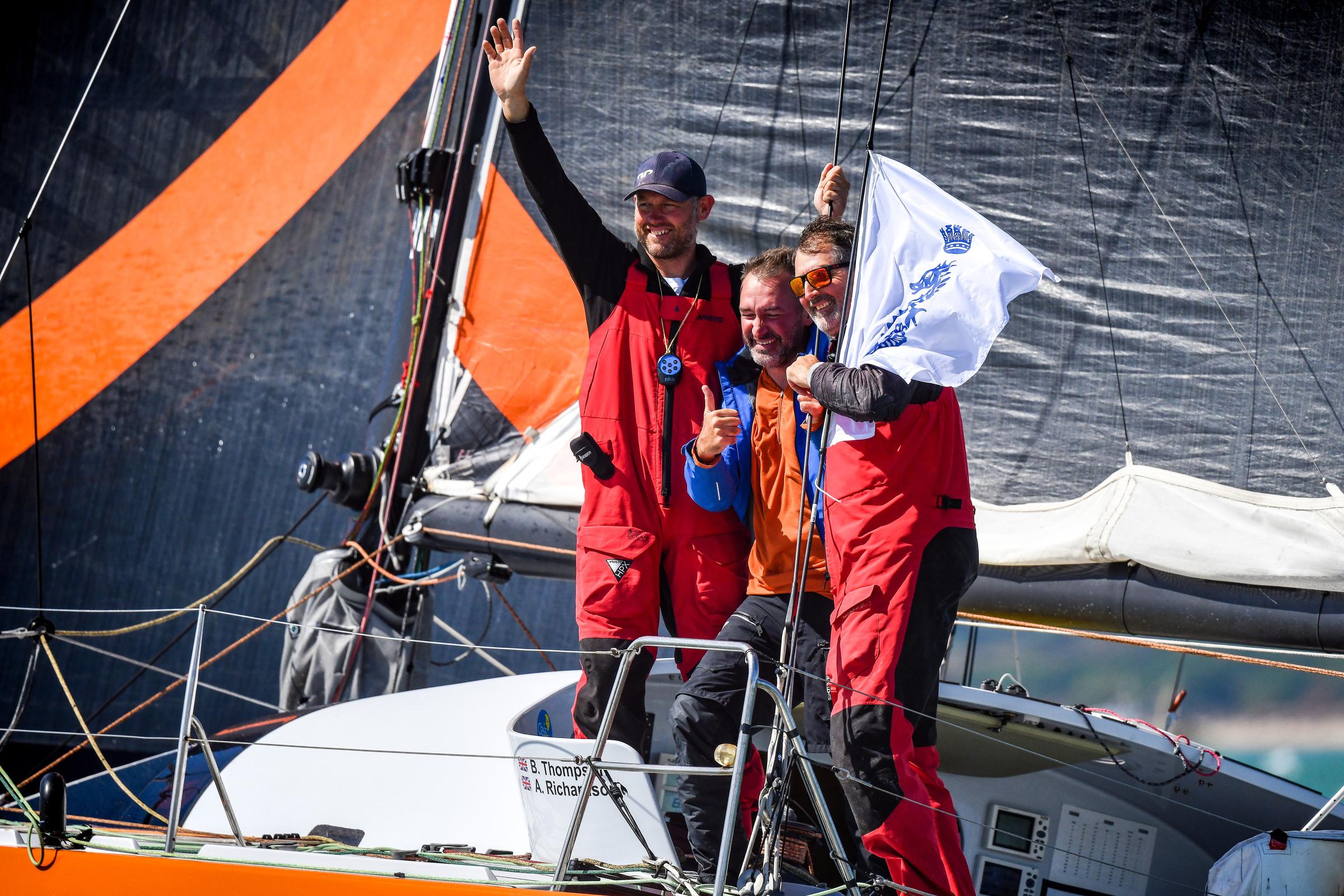 James McHugh's Class40 Tquila winner 2022 Round Britain and Ireland Race © James Tomlinson/RORCLearning from every boat
Although Thompson is best known for racing giant multihulls, his sailing remains remarkably varied. He can be found navigating the MOD70 Argo, racing a Class40 or sailing aboard a classic yacht. For him, the different disciplines are complementary, rather than separate.
“You learn something from every boat that is applicable to the others,” he explains. “Each one presents a different challenge, with different people aboard and different competitors around you.”
Racing MOD70s in the Rolex Fastnet Race or RORC Caribbean 600 can become a high-speed match race between two or three powerful trimarans. A Class40 race presents a different tactical problem, with perhaps 20 or 30 boats competing for position.
“Technically the boats are different, but fundamentally you are trying to make the boat go as quickly and safely as possible to the finish,” says Thompson. “The more boats you have, the more interesting it becomes tactically and navigationally. You can really test yourself in different environments.”
That breadth of experience also shapes his view of the often-misinterpreted distinction between professional and Corinthian sailing. Thompson rejects any suggestion that amateur status is a measure of ability.
“Many Corinthian teams are at the level of professional teams,” he says. “The talent within them is equal and they approach their racing in a methodical, intelligent way. They prepare the boat well, bring in coaching and build up through training and racing towards their main event.”
The principal distinction between the two types of teams is time—usually only available to fully professional teams. More training days and greater resources can refine every element of preparation. However, Thompson believes a well-organised Corinthian campaign can still close much of that gap.
“A good Corinthian team can beat a poorly prepared professional team,” he says. “Corinthian sailors are becoming increasingly professional in their approach. Moreover, RORC racing also involves coping with changing weather, tidal gates, tactics and navigation, so a good team can always have its day.”
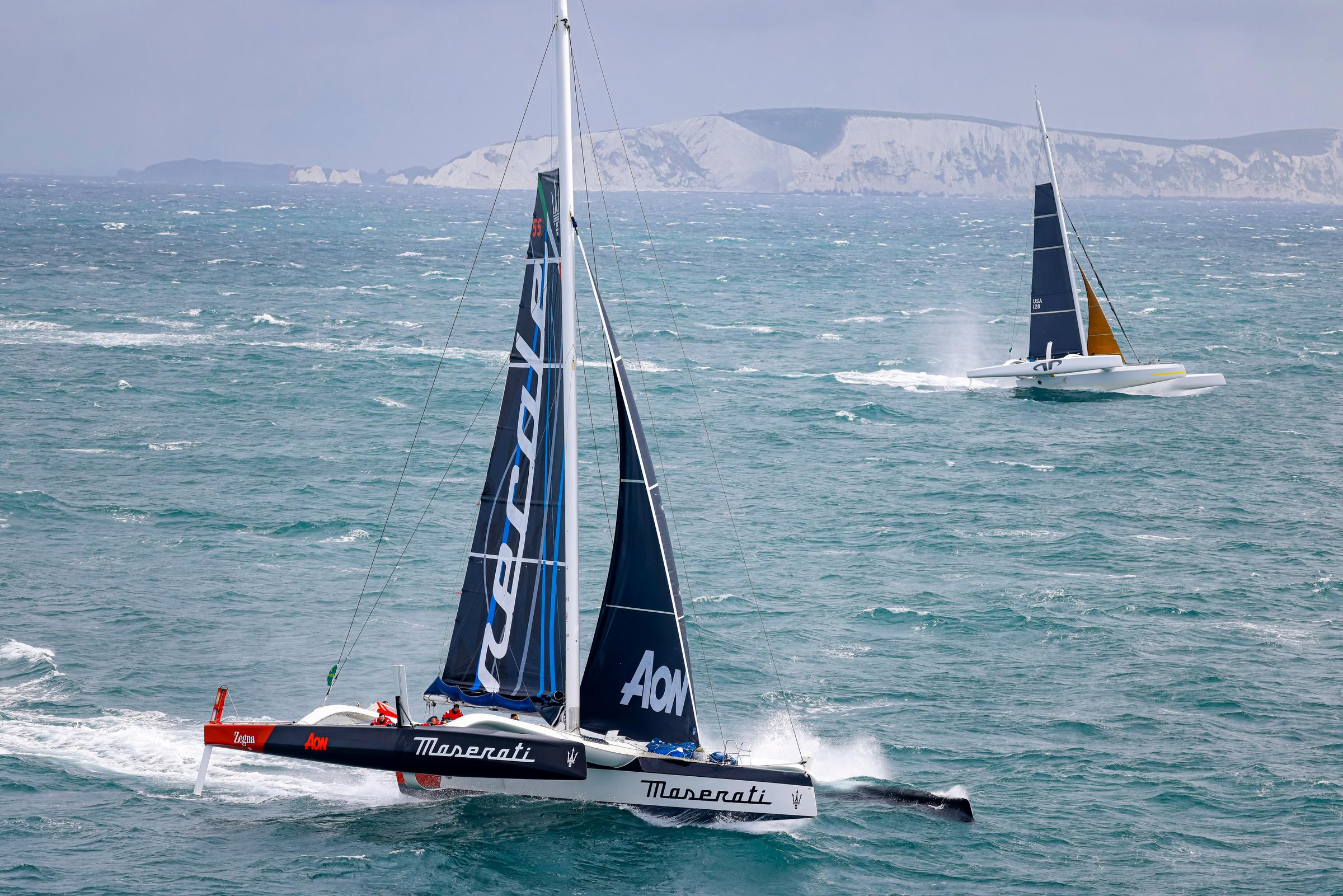 Rolex Fastnet Race - Maserati and Argo © Carlo Borlenghi/ROLEXCompetition addiction
After so many miles and achievements, Thompson might reasonably be expected to have lost some of his competitive appetite. Instead, he remains captivated by the entire process.
“I still love the preparation before a race,” he says. “Looking at the weather, calculating the routing and working through the tactics. The adrenaline is definitely pumping on the way out to the start, and that hasn’t changed.”
Once racing begins, Thompson describes entering a state of complete concentration.
“The feeling you get when you are racing is absolutely addictive. You push yourself harder than you do in almost any other walk of life. You want to do your absolute best and reach the finish knowing you have done as much as you possibly could.”
He takes inspiration from sailors who continue competing because the activity itself remains compelling, rather than because they have anything left to prove.
“Take Paul Cayard, he is in incredible shape at 67 and he has just won the Star and Etchells Worlds. If you love doing something, you should keep doing it,” he says. “I feel very lucky to have had such a long career and to continue getting that excitement from racing.”
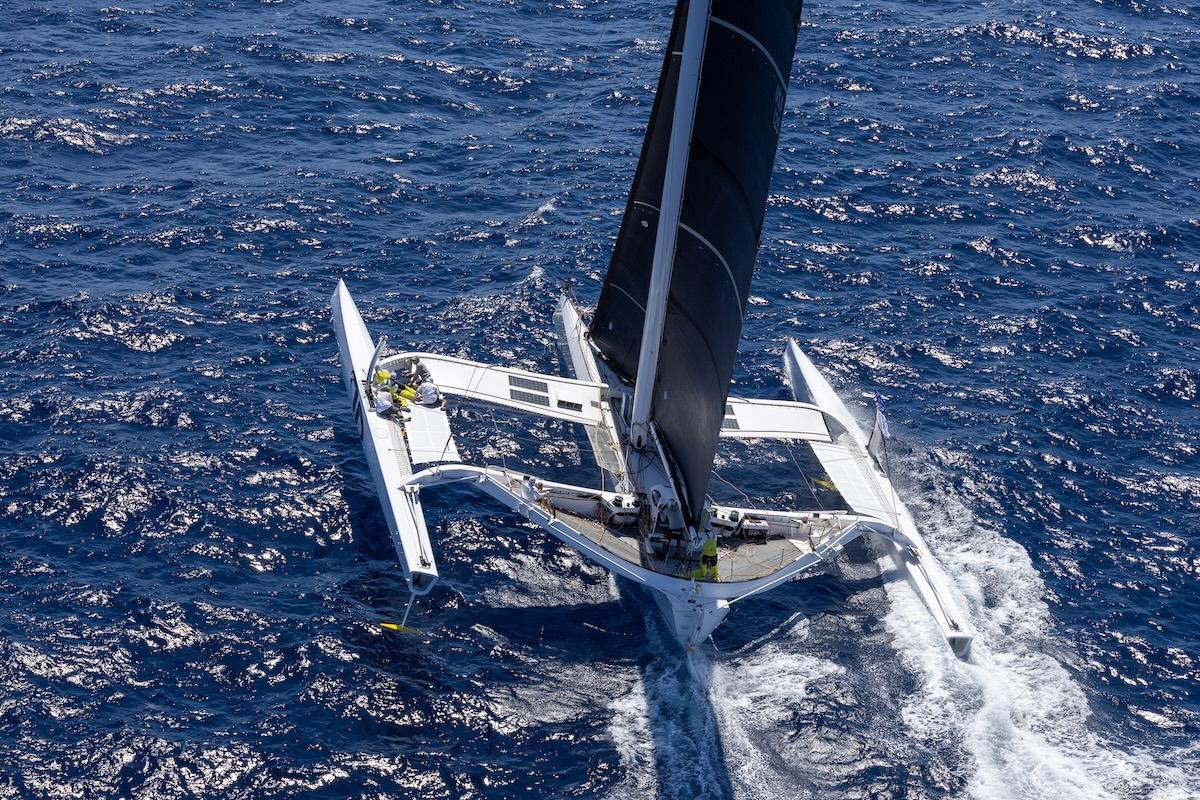 MOD70 Argo © Tim Wright/RORCArgo performance loop
Thompson’s recent career has been closely associated with Jason Carroll’s Argo Racing team. On the MOD70 Argo, he serves as navigator but is also deeply involved in the boat’s performance.
“I do the navigation, but I am also involved in what we call the speed loop,” he explains. “That includes the balance of the boat, which sails we should carry, how they should be trimmed and how we use the daggerboards and foils.”
Navigation on a high-performance multihull cannot be separated from the boat’s configuration. The quickest theoretical route is of little value unless the boat can sail it safely and efficiently.
“It is all part of the navigation and tactics,” says Thompson. “The objective is to get the boat safely and quickly in the direction we want to go. I really enjoy being involved in the performance side and working with the whole team to achieve the best result.”
The MOD70 Argo has evolved significantly, including the introduction of lifting foils and T-foil rudders. However, Thompson is careful to distinguish the modified MOD70 from the latest fully foiling Ultims.
“Argo is not completely foiling; it is more accurate to say that it is skimming,” he explains. “The leeward float can be airborne or just touching the surface, but the central hull is generally still in contact with the water. A fully foiling Ultim can be completely clear of the water and considerably faster in the right conditions.”
Argo’s maxi-multihull project
Argo Racing’s next chapter is considerably larger. The team is working with VPLP on a new 32-metre Ultim-sized trimaran, with construction expected to begin in 2027 and a launch targeted for 2029. The project will move Argo Racing into a realm of performance beyond the capabilities of the MOD70.
Among the primary ambitions are the west-to-east transatlantic record from New York to the Lizard and the outright 24-hour sailing record. The Route of Discovery from Cádiz to San Salvador is another major objective.
“The New York to Lizard record is one of the big targets,” says Thompson. “By the time we launch, the Banque Populaire V record will have stood for well over 15 years. The 24-hour record could potentially happen during that attempt.”
The current benchmark is just over 900 nautical miles. Thompson believes the apparently extraordinary milestone of 1,000 nautical miles in 24 hours is achievable.
“I think 1,000 miles is possible in the right conditions,” he says. “You would need relatively flat water and a wind system that travels with the boat for the full distance. A steady trade wind would create too much sea state. Ideally, you would ride a low-pressure system, moving into flatter water as the wind increased.”
Sustaining an average speed of more than 40 knots would demand a new level of reliability, aerodynamic efficiency and control.
Designing for weather
Thompson is actively involved in the design process, attending regular meetings with VPLP and the project’s consultants in Vannes.
“It is a real privilege to be involved,” he says. “We have in-person meetings approximately every month, as well as regular calls to review progress. It is a huge team, involving specialists in areas such as sails, hydraulics, the rig and the platform.”
He has also contributed to detailed weather studies for both the North Atlantic and Route of Discovery courses. These studies will help determine the boat’s design parameters, from foil configuration to structural loads and target performance ranges.
Climate change adds another layer of complexity. Changes in storm patterns, hurricane activity and the movement of ice could all influence future record windows.
“Yacht racing is a very small and unimportant part of the overall impact of climate change,” Thompson says. “But it is an indicator. The weather is changing, and that inevitably changes how we consider these record courses.”
For all the sophistication of the maxi-trimaran, Thompson sees continuity with every other form of sailing. Preparation, reliability and judgement remain essential, whether racing a classic yacht or travelling at more than 40 knots aboard a foiling trimaran.
“The principles are transferable right across the sport,” he says. “The equipment has to work and the preparation has to be right. The loads on a J Class are incredibly high, and they will be equally high on an Ultim.”
1.jpg) Brian Thompson © @RoddyAcquafilms/RORC
Brian Thompson © @RoddyAcquafilms/RORC
Route into professional sailing
Thompson is enthusiastic about the RORC Griffin Pathway and its role in helping young sailors discover whether they want to pursue professional sailing or develop their skills as committed Corinthian competitors.
“The Griffin project is doing amazing work,” he says. “I am really happy to see RORC embracing it. It will help keep the Club moving forward for decades to come.”
His principal advice to aspiring professionals is to combine a specialist skill with broad sailing knowledge: “A technical skill makes you more valuable to a team,” he explains. “That might be sailmaking, engineering, navigation, data analysis, boatbuilding or computing. Having a speciality can get you onto the boat.”
Once aboard, versatility becomes equally important: “Offshore, particularly when short-handed, you need to be able to slot into different roles. You should understand navigation and tactics, be able to trim sails and contribute to sail handling. The ideal combination is a speciality that gets you onto the boat and a broad range of skills that keeps you there.”
Thompson also sees short-handed racing as an outstanding pathway. Strong results in a two-handed boat demonstrate self-reliance, judgement and competence across multiple disciplines.
He could have pursued a very different life. With an economics degree and plans that once included an MBA and a possible career in finance, he stood at a genuine crossroads. He chose sailing.
“Many successful people take up yacht racing when they retire. I have simply been fortunate enough to make it my life.”
After more than four decades at the cutting edge of racing, Thompson remains excited by the start of every race and fascinated by the next generation of boats. From RORC’s classic offshore courses to the theoretical possibility of covering 1,000 miles in a single day, the horizon continues to move—and he is still chasing it.